From the old to the new
Restoring The Lord's Supper ~ PART 3
"...Blood, Words and a Fellowship Meal... It should be of no surprise to us to learn as we turn to the pages of the New Testament that the same principles equally apply."
So we see from just a few examples that in olden times the principles of covenant making involved: Blood, Words and a Fellowship Meal. It should be of no surprise to us to learn as we turn to the pages of the New Testament that the same principles equally apply. Jeremiah had prophesied centuries earlier that one day The Lord God would make a New Covenant with His people. That time had come. The ministry years of the Lord Jesus Christ were at their pivotal moment and He was ready to ratify that New Covenant with His disciples. How did He do it? Simple, He spoke to them (WORDS), had dinner with them (A COVENANT MEAL) and was beaten and died sacrificially on the cross (BLOOD). The confirmatory seal of this New Covenant came a few weeks following, at the Feast of Pentecost.
The special passover meal
As you know well, the night before Jesus died He directed His disciples to make special arrangements for a Passover meal that He was to partake of with them. It was a dinner of lamb and particular herbs and various other elements, which all in varying ways represented the nation’s salvation and exodus from Egypt. Integral to that meal was bread and wine.
The bread of life
Jesus had previously used ‘bread’ as a symbol of His divine life. Most of John chapter six is taken up with this theme. First, He miraculously divides five loaves (plus two small fish) among five thousand people. They are so filled and so thrilled that they are soon after ready to make Him their king, but this was not His time for that. He had to further teach them that what they all really needed was not mere earthly bread, which only sustains the body for a short while, but rather spiritual bread, which can sustain a perpetual, immortal life. God had sent bread from heaven (manna) to their fathers in the wilderness many years before. It only lasted for one day at a time (or two in the case of the Sabbath provision). Jesus told the people that God had sent Him as bread from heaven too. Not to sustain their mere natural needs but to be the Bread of Life – eternal, immortal Life.
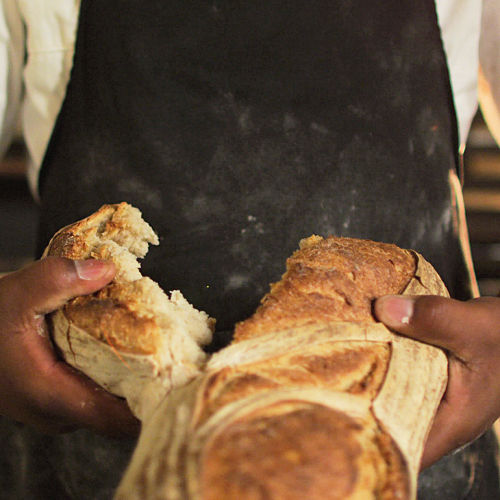
As the Passover meal progressed Jesus gave thanks, took the bread, broke it and then revealed the next part of the plan... ‘This is My body which is given for you;’ (Luke 22:19). He used the Matzah* bread to demonstrate the pending destruction of His own mortal flesh, the ‘Bread from Heaven,’ Jesus Himself, He was about to be broken and distributed to many. He also added, ‘Do this in remembrance of Me.’ And so the symbolism of literally breaking a loaf of bread and sharing it among His disciples as a token of the real ‘Bread of Life’ was established in this moment.
* (The Passover Matzah used among Jewish people to this day is usually pierced and striped. Pierced - like nails in a hand. Striped - like a scourged back. How utterly sublime! I am uncertain as to when this tradition first began and would love to know if there is clear evidence. Perhaps it was already the practise from Old Testament times? In any case, this, along with many other curious Passover traditions, is a very evident testimony and witness to a people, which for the most part still have no idea that Jesus was their Messiah. One day they will all know!).
The passover seder* & the four cups
*(‘Seder’ comes from the Hebrew word for ‘order,’ referring to the scripted activities of the Passover meal, which include: the assigned prayers, reading portions, the breaking of the Matzah, the cups of wine, etc.).
In addition to the pierced and striped Matzah bread it is generally understood that by the time of the first century the Passover Seder already followed the tradition of including the four special cups of wine (four ‘refills’ as usually practised today). Though not explicit in the text of Scripture there are some clues that this ritual was adopted at the Last Supper. Luke’s Gospel specifically mentions a cup before the meal (Luke 22:17) and again later another cup after the meal (Luke 22:20). (Arguably and interestingly, Jesus was offered another (fourth maybe) ‘cup’ at His crucifixion). Anyhow, I’ll briefly summarise the four cups that are traditionally used in the Passover Seder.
Each participant’s cup is filled/refilled four times and a ‘toast’ of remembrance is made to the four ‘I Wills’ of the Exodus:
- I will bring you out (from under the burdens of the Egyptians).
- I will rescue you (from their bondage).
- I will redeem you (with an outstretched arm and with great judgments).
- I will take you (as My people and I will be your God).
These four great ‘I Wills’ are found in Exodus 6:6,7.
When we read all of these ‘I wills...,’ and especially the last one, ‘take you to be mine’ (I paraphrase), we can’t but help think again of a marriage ceremony. This was in fact the beginning of God’s ‘marriage’ to the people of Israel back in Exodus and is exactly this in the New Testament Last Supper, as Jesus began the process of His marriage to His bride, the Church.
It was a special dinner
In saying all that I have above, mentioning the Matzah bread, the four cups etc. it is not my intention in this article to attempt to bring out the deep spiritual meaning of the bread and wine or provide an in depth explanation of the Jewish traditions of Passover meals. Many others have taught and expounded upon these things far better than I could. For the purposes of my present focus and where I wish to lead you dear reader is the sublimely simple observation that the context of the very first ‘Lord’s Supper’ (so called) was a special meal. There was drinking, not just once but several ‘toasts’ of remembrance were given. (Let’s not talk alcohol and strength and grape juice and abstinences here, I’ll make a brief mention of this later). The bread, albeit unleavened, was a substantial quantity, sufficient to feed and fill those present, along with the meat, herbs and other elements. For all of the occasion and ceremony it was still ‘dinner time’! They were not gathered to partake of one small mouthful of bread and one delicate sip of juice. They were gathered for a feast, and it is in THIS context that the bread and wine were given their new, spiritual and elevated meaning.
The corinthian symposium
So we see that the original Lord’s Supper was part of a full, proper, shared meal and now we shall also see that some years later (30 or so at a quick estimation) the Church at Corinth had been doing exactly that, albeit, it had become terribly abused and misused.
PLEASE READ 1 COR 11:17-34.
Oh dear, Oh dear, what a terrible, self-serving, horrible, fleshly mess this church had gotten into. What we see here is a picture of The Lord’s Supper gone crazy! So much so that Paul says (in utter exasperation I‘m sure), ‘This is not The Lord’s Supper!!!’ (exclamation marks added!). It seems that the once, wholesome practise of gathering together for a communal sharing of food and godly fellowship had devolved into something more akin to a Greek symposium – a party for overindulgence, drunkenness, a cocktail of heady philosophical discussion and sometimes even unrestrained physical lust. I will leave the reader to research further the range of symposiums but it seems that the Corinthians were being influenced by their surrounding worldly, pagan culture.
However, despite the negatives that were being highlighted and addressed in the situation we can nonetheless ascertain very plainly that The Lord’s Supper was:
- An evening gathering of the church. Paul refers to it as ‘supper’ and says that they should ‘wait’ for each other before commencing – perhaps some were late workers.
- Plenteous in food and drink. Not a mere ‘ceremony’ where one single small morsel of bread is eaten along with a delicate single sip of wine.
- Meant to be a kind of ‘bring and share’ meal. In a society where there was genuine poverty this was one opportunity of a real ‘treat’ occasion for those who did not usually live richly. The rich would humbly accept and participate in the contribution of the poor and the poor would benefit from the quality and quantity brought to the feast by those who were more richly endowed.
And so my point here again is this: Whatever the abuses and misuses that were going on at Corinth, it is crystal clear that 30 years on, a couple of thousand miles away, in an entirely different culture and setting, the New Covenant tradition that Jesus had commenced the night before He died was interpreted as being something that was to be done in the context of a meal, a fellowship feast.
It is not for us to say, we don’t want to end up like those naughty Corinthians so we’ll just change that and abandon the original practise altogether. No, this is not the correct response. The Correct response is to say, let’s always follow the biblical pattern and take as serious warning the examples of others who went astray. There is an old saying that fits the bill here so well, it is this: THE CORRECT RESPONSE TO ABUSE IS NOT NON-USE BUT RIGHT USE.
Ancient Corinthian abuse of The Lord’s Supper is not our excuse to abandon the original intended practise, along with all of the spiritual enrichment it brings through the joy, fellowship of love and intimacy of a shared meal. For those that believe that the New Testament provides the God-authorised pattern for all church practise the Last Supper/The Lord’s supper, as recorded in the Gospels and Paul’s letter to the Corinthians (minus the abuses!) is a very clear statement that the bread and wine remembrance is meant to be carried out in the context of a fellowship meal.
Old & new testament covenant meals
We saw in the previous section how that a group of men went up from the camp unto Mount Sinai for a special covenant meal as a part of instituting the Old Covenant (Mosaic Covenant). While this particular special event meal was not repeated the finer detail of that Covenant ordained that there should be continual, ongoing covenant meals before God. I do not just refer to the annual feasts only, but also much of the sacrificial system and offerings were taken up with ‘fellowship offerings’, which involved eating together with the priests and with others as part of a fellowship offering. In much the same way, Jesus’ special, one-off Last Supper with His disciples was indeed a once only meal event. We are not instructed to follow the precise rituals of that Passover meal again but the essence of that meal is to be translated into all the churches in their various locations across the ages. Our food and precise manner of coming together to eat will vary but the central features will be there – a gathering of The Lord’s people (this is not for unbelievers) to eat a full meal and IN THE CONTEXT OF THAT MEAL break the bread and share the cup in that special remembrance of our Lord. So, both the Old and the New Covenant were instituted with a one-off special covenant meal (in addition to the Words and the Blood) and in both cases provision/commandment was made to continually remember the covenant through the act of ongoing, shared, communal meals.
Midway summary
In many ways I could just end this article here. I have come to my main point and reiterated it already. The Lord’s Supper was instituted as part of a meal. It continued to be practised as a shared fellowship meal. We should follow the biblical pattern for this. We miss out spiritually, as well as naturally, by not following this practise as intended. We could just leave it here but if you want to read on then in the next two sections I’ll be adding a little more overview information in the form of: Part 4 ~ Summarising terminologies and Part 5 ~ A question and answer section. I may not precisely answer everything but at least we would have asked the questions and not just ignored them! So, if you are keen to continue then please do read on...
Sponsored
You may also like:

Food is fellowship
Restoring The Lord's Supper ~ PART 1

Covenant making for dummies
Restoring The Lord's Supper ~ PART 2

Terminology
Restoring The Lord's Supper ~ PART 4

Questions & conclusion
Restoring The Lord's Supper ~ PART 5