Questions & conclusion
Restoring The Lord's Supper ~ PART 5
"These are questions I have, and continue, to ask myself and you may be asking these questions too, plus others no doubt."
In essence I have already said, and now written, what has been burning in my heart to say, and finally write, for so many years. The Lord’s Supper (also known by various other biblically assigned names) was never, ever just a little piece of bread and a sip of something, taken whilst seated in rows in a ‘heightened religious atmosphere’. It was a meal, a full meal, with food, drink, talking and interacting in a normal human way. This is, by God’s design, one of the most powerful expressions of human and spiritual fellowship and a God ordained means by which relationships are formed and deepened. This now only leaves me to try to briefly answer a few questions which are only reasonably to be expected. These are questions I have, and continue, to ask myself and you may be asking these questions too, plus others no doubt. It is not my intention to deal with all arguments for/against and speculations concerning these questions. For the most part my answers will be fairly inconclusive. It just seems reasonable to include them here.
But before I embark on these more fine detail issues I have a confession to make – in full and transparent disclosure... At the time of writing this long overdue article I have been ‘in The Way’ for nearly 40 years and in all of that time I have never witnessed or participated in the kind of Lord’s Supper meal that I have been describing. That may be shocking for you to hear having come this far in the article with me. I can certainly say that it is a devastating and gaping hole in my own Christian experience up until now. The closest I have come to the simple ‘spirit’ of the matter is on a handful of occasions, when sharing a meal with our closest and most like-minded brothers and sisters. Just half a dozen folk enjoying one another’s company and a good meal and then it has been spontaneously suggested that we remember The Lord in that particular/special manner. Those moments have been a treasured blessing, with everyone being of like mind, but I wouldn’t easily suggest it when in the company of many believers, who we know to be far more formal and ceremonious about such a thing, as they may easily be offended or consider our meal to be sacrilegiously tainted by it. Oh well, deep sigh... such is the reality up until now but I shall endeavour to answer a few questions, in theory at least, as I cannot claim the experience of wider practise. So here goes...
I’ve already mentioned in the course of this article that there were ‘daily’ meetings of the early church and that disciples regularly ate together on any day of the week. Maybe these meals included ‘remembering the Lord’ in this manner, maybe they didn’t. I cannot say. But I certainly can’t see any prohibition to doing this on any day and the teaching of the New Testament is totally clear (to me at least) that the New Covenant is not a calendrical-driven covenant (unlike the Old Covenant). So, no, there’s no special day on which this can or cannot be done.
I have noted that the examples in the NT, and the terminology used, suggest that it was, in their day, usually an evening meal, however, I cannot see any grounds to insist that it should always be so. Personally I’m happy to eat and enjoy Christian fellowship at any time of the day.
I cannot see any grounds to argue it should – I’m personally happy with once per week, once per month or on an ad-hoc basis – as suits/fits each local assembly.
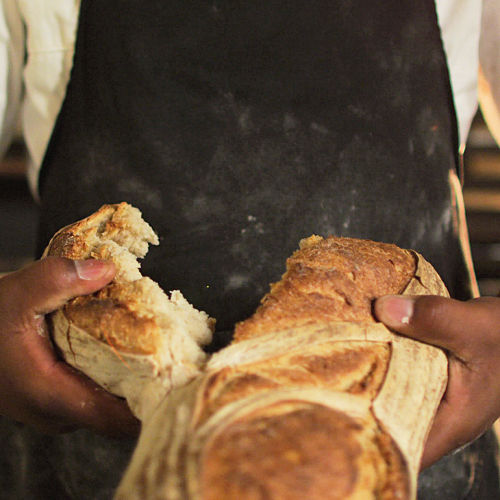
Clearly the inaugural Lord’s Supper – i.e. Jesus’ Passover meal with the disciples – utilised unleavened bread, as this was commanded for Passover observance. However, although the Lord used this Passover meal to initiate this new symbolic act there’s no sound reason to suggest that the bread used on all future occasions should not simply be anything other than the common bread of that particular place and culture. So far as I’m concerned, if the cupboard was bare and there were only biscuits or crackers and no bread at all I would not be in the least bit concerned personally. They would do fine so long as we maintain the ‘spirit’ and true meaning of what we are doing.
My answer would be basically the same as the one given above regarding what type of bread we should use. However, there are some other practical considerations here. Some Christians are culturally very uncomfortable with alcohol consumption (although there is no biblical reason to be so), so it may just save some other debates if grape juice, or some other non-alcoholic substitute, is used. On the other hand, if the practice is to pass the cup from mouth to mouth (see next question) then I would personally much prefer that we use real wine or port or something like that because alcohol is a natural antiseptic and we are far less likely to pass on germs this way.
As there is definitely no instruction about this or any clear pattern I cannot see any grand importance to it. Passing a cup from person to person certainly represents intimacy but so can everyone having the same drink in their own cup and all drinking together. In many cultures, today and in the past, at a special celebration, it is very common for everyone to fill their glass, make a toast, and all drink together. Considering the original Lord’s Supper (The Last Supper), reading in Matthew, one might get the impression of one cup being passed. Reading Luke (where two of the four usual Passover ‘cups’ are mentioned) I can more picture the disciples taking Jesus’ cup (which He said He wasn’t going to drink) and ‘splitting’ it between them – like at a family meal where mum says, I’ve had enough of this drink, who would like it and it gets poured into the kids glasses in roughly equal measure. Anyhow, here’s the quote from Luke which more conveys that scene: ‘Then He took the cup, and gave thanks, and said, Take this and divide it among yourselves;’ Luke 22:17 Personally, and in the culture I live in, there is a uneasiness with sharing a cup with anyone other than immediate family members. Plus, since the whole Covid debacle I would certainly prefer to ‘divide’ a cup into our own cups rather than pass one round.
I’m quite sure that children ate communally with their families’ friends and churches but whether or not they were present for that ‘special’ communal meal I do not know. The Bible does not tell us. Certainly the original ‘Last Supper’ had neither children nor women present. The Acts 20 Troas meeting (if it was a Lord’s Supper not just an everyday meal together) started late and ended very late and so perhaps there were no children present (?), but… perhaps there were (?). Bottom line is, I do not know and have no other thought about this at this present time. This also leads to a sub-question… If children are present should they partake of the communal bread and wine/juice? Again, I don’t have anything specific to say on this matter other than having many varied, random thoughts and ideas and other theological speculations. So I’ve leave this whole topic for now.
In 1 Corinthians 11 it gives the impression that this was a city-wide occasion. Not just a handful of folk from one little ‘house-church’ but a bigger gathering (perhaps held at a larger than usual venue even?). If the term ‘Love Feast’ was referring to The Lord’s Supper it may also convey a larger ‘party atmosphere’. But as we all know, things today are much more fractured than at the beginning so we must work with what we have – albeit grand or small.
Bear in mind that this is a ‘family’ gathering – i.e. it is for those who are of Christ’s family. Bear in mind also that this is an occasion where we should ‘examine ourselves (‘to see if we are walking in faith’) then without hesitation my answer to this is a firm no. However, as with all things in the Christian life and with relevance to any of our gatherings there is always the ‘spirit and the letter’ to be considered. I am not legislating but I would not, unless otherwise The Lord was to overrule somehow, expect this to be an occasion for anyone other than the ‘family members’ – true believers only, who are unquestionably walking in The Way.
Whatever you like! Ideally/normally, everyone should contribute, as this is all part of the sharing together (but there’s equally no prohibition on someone providing the supper if that is in their hearts to do so). If you’re American or German someone will undoubtedly organise everything and everyone else will thank them for their efforts in undertaking to do so. If you’re English then probably no-one will organise anything with any great clarity, or if someone does attempt to take on such a mantle (because they just can’t abide the chaos!) then they’ll probably be forever labelled a dictator! But hey, some of us have to bear that cross so everyone else can be wholly edified. Whatever you like to eat and however you organise things (or not!) just don’t give nuts to anyone with a nut allergy or absolutely insist that the vegetarians must eat the sausage rolls to prove their gratitude to the person who made them.
As we are not provided with any precise pattern for a Love Feast it is hard to say exactly what should take place in any detail. Firstly, I’d just say that whenever real believers, who are walking with God, come together in any situation there is invariably always talk of the things of God. We don’t need to legislate about what people chat about during the dinner and of course it would be perfectly normal to talk about the kids, the car, the job and all the usual stuff of life. But it would be a strange mealtime if everyone was trying to read, sing, pray, etc. whilst eating. But given the situation I’d say that it would be an ideal opportunity for any/all of the above at some stage in some way. The ‘rule’ is simple… we’re there to glorify God, as indeed we should be doing in all our behaviour all day long, and edify one another. If it’s edifying and helpful, and not forcing plastic religiosity into the situation then I say, let’s do it! I’d just add that as with most church gatherings there will be those present who are elders and I think they should lead/oversee the proceedings.
Once again I’d say there’s no set pattern. See what fits. See what works. See what flows.
This is not important to our conclusions of how things should be but just out of interest… I have read that there is some evidence that this began to change as early as the second century – so it didn’t last long! By the end of the fourth century, the ‘Love Feast’ was actually prohibited by the Council of Carthage. This also coincides with the further formulation of other strange ideas such as, that the ‘priests’ (so called) had the power to change the ‘sacraments’ into the actual body and blood of Christ. I’ll leave you to your own research on the history.
Conclusion
So that’s it. It’s incredible when I think about it that so much has to be said to convince Christians to do that which is one of the simplest, most natural, God-given pleasures on earth - get together with your ‘friends’ (Christian family), eat some nice food and remember the Lord whilst we’re doing it all. There’s no need to get all ‘religious’ about it but at the same time use it in some creative way (be creative! why not! God is!) to 'build one another up in our most holy faith.'
God bless you in your communion meal if ever you should get to participate in one, and please, let me know how you do it.
Sponsored
You may also like:

Food is fellowship
Restoring The Lord's Supper ~ PART 1

Covenant making for dummies
Restoring The Lord's Supper ~ PART 2

From the old to the new
Restoring The Lord's Supper ~ PART 3

Terminology
Restoring The Lord's Supper ~ PART 4