Terminology
Restoring The Lord's Supper ~ PART 4
"Let’s see what insight we can gain from briefly reviewing these terminologies. This is just a succinct summary, no Greek dictionary exploration, and I am using the NKJV."
There are several commonly employed terminologies in respect of our subject matter. Some are biblical words and phrases and others have later derivations. Among the latter are such terms as: ‘Eucharist’, ‘Mass’, ‘Sacrament’ and doubtless there are other officious-sounding, ecclesiastical terminologies that have been used. I am not going to address these latter words as they are not directly used in any common English translation of The Bible and are mostly used in Catholic or High Anglican churches. I want to stay focussed on the plain biblical terminologies, familiar to all English Bible readers, which are (using NKJV):
- Communion (Used twice in one verse in relation to The Lord’s Supper - 1 Cor 10:16. But also used twice in 2 Corinthians in a more general sense).
- The Lord’s Table (Used once - 1 Cor 10.21).
- The Lord’s Supper (Used once - 1 Cor 11:20 – used interchangeably with ‘The Lord’s Table’).
- Love Feasts (Used once - Jude 1:12).
- Breaking of Bread (plus variations of this phrase) (Used multiple times throughout Scripture – to be addressed at the end of this section).
Let’s see what insight we can gain from briefly reviewing these terminologies. This is just a succinct summary, no Greek dictionary exploration, and I am using the NKJV.
Communion
The word ‘communion’ is used a few times in Paul’s writings to the church at Corinth. Only in one verse is it used in obvious relation to the ‘bread and wine (or, the cup).’ The reference is as follows:
‘The cup of blessing which we bless, is it not the communion of the blood of Christ? The bread which we break, is it not the communion of the body of Christ? 1 Cor 10:16
He goes on to talk about the contrast of having communion/fellowship with God as opposed to drinking the ‘cup’ of demons. In other words, he is using the Lord’s Supper as an object lesson. We should be eating the bread and drinking from the cup to signify that we are eating and drinking of Christ. It’s a terrible hypocrisy if we participate in the Lord’s Supper whilst living lives in ‘communion’ with demons! He picks this up again in the next chapter and talks of people becoming weak and sick due to their disrespect and contempt of this holy symbolism and participating in the communion meal unworthily.
From this verse I would say that ‘communion’ is a valid, designated term relating to the fellowship communal meal. Albeit, it more refers to the principle of uniting fellowship – during that meal, and at other times – rather than being a direct reference to the communal meal itself.
The lord's table
The phrase ‘The Lord’s Table’ is used just once and occurs as a part of the Corinthian passage cited above.
‘You cannot drink the cup of the Lord and the cup of demons; you cannot partake of the Lord's table and of the table of demons.’ (1Cor 10:21)
As with ‘communion’ Paul is using it as a figurative expression, meaning ‘eating with The Lord’ – for that is what we do at a table. To ‘eat’ with somebody means to share fellowship with them. You can’t have supper with God and then partake of breakfast with the devil!
From this verse and its usage, I would say that ‘The Lord’s Table’ is another valid, designated term for the fellowship communal meal.
The lord's supper
I’ve already said some things about ‘The Lord’s Supper’ in the previous section. When rebuking the Corinthian church for their appalling abuse and misuse of the fellowship meal he exclaims, ‘This is not The Lord’s Supper!!!’ But from that scene we can deduce what The Lord’s Supper is meant to be; a gathering of the Believers, to share and partake in a supper time (evening) meal together.
Despite its negative context it is clear that ‘The Lord’s Supper’ was the clearly recognised terminology among the Corinthian church.
Love feast
The ‘Love Feasts’ being referred to by Jude are understood to be referring to the church’s communal meal. This term beautifully summarises the true spirit of a communal meal - sharing love as well as sharing food.
‘These are spots in your love feasts, while they feast with you without fear, serving only themselves...’ Jude 1:12
As with all three of Paul’s terminologies outlined above, sadly the term ‘Love Feast’ is also only used in addressing a dark and sinister blighting of this most holy fellowship meal. In the case of Jude, he is warning against the presence of those, at the meal, who are insincere, ungodly types who are only there to ‘serve themselves’. However, for the purposes of our terminology summary, we can definitely add this one to our list as another recorded, inspired terminology for the holy, fellowship meal of God’s New Covenant people.
Summarising the four terminologies
No, I’ve not forgotten about the ‘breaking of bread,’ and we’ll come to that next, but first let’s just summarise the above four terminologies, which were:
- Communion
- The Lord’s Table
- The Lord’s Supper
- The Love Feast
All four of these are divinely recorded, divinely inspired terms describing a gathering of God’s people participating in a shared communal meal, during which, in some manner, the bread and the cup are passed/shared in remembrance of the Lord’s striped and pierced body and His shed blood – for the remission of our sins. This act of remembrance (looking back) during the meal also looks forward to His reappearing too. We will not be dwelling on this but here are just a couple of quick quote reminders of that:
‘But I say to you, I will not drink of this fruit of the vine from now on until that day when I drink it new with you in My Father’s kingdom.’ Mat 26:29
‘For as often as you eat this bread and drink this cup, you proclaim the Lord’s death till He comes’. 1Cor 11:26
Interestingly, and a revelation to me as I was writing this article, every one of the above references to the communal fellowship meal, as practised by the early church, is in a negative context. In other words, this meeting and eating together was utterly abhorred by Satan and his minions and was the target of his continual attention and attack. Why was that you may wonder? A big part of the answer has already been given in the introduction to the article – namely, eating together produces and deepens human relationships in a way that has the potential to ‘join’ people together way beyond the superficial ‘acquaintance’ level. If the Body (of Christ) is joined genuinely, closely and intimately together then the Blood (Life of Christ) can begin to circulate through its veins, making it truly, spiritually alive. So much more deeply alive, and functioning, than a group of people that are a part of a mere ‘organisation’ that only shares some formal ‘services/ceremonies’ together.
(A quick note on ‘The Last Supper’... This has not been included in our summary of terminologies as it only relates to the one Passover meal that Jesus ate with His disciples the night before He was tried and executed. It’s also not in the Bible. However, I have employed it a few times in this article as it is a universally accepted and understood manner of referring to that one-off occasion. I’ve never heard it used to describe the on-going fellowship meal.)
Breaking bread
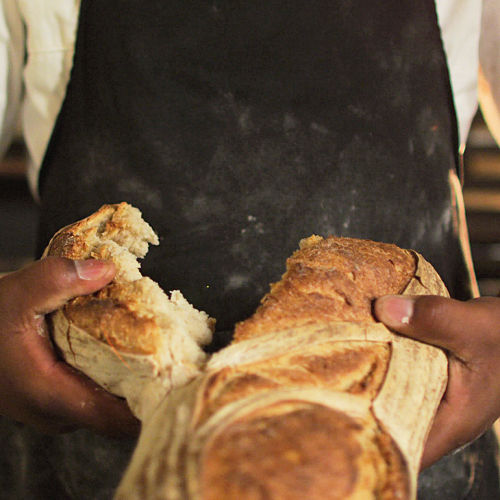
Finally, in this section of summarising terminologies we come to the phrase, to ‘break bread’. The phrase, to ‘break bread,’ ‘brake bread’ (KJV sometimes), ‘breaking of bread’, similar/etc. is used multiple times throughout Scripture. It can be found in both the Old and the New Testament. Here is perhaps the clearest usage from the Old Testament:
‘Nor shall men break bread in mourning for them, to comfort them for the dead; nor shall men give them the cup of consolation to drink for their father or their mother.’ Jer 16:7
The ‘break bread’ part in the above quotation is variously rendered in alternative translations as, ‘take food to them’, ‘provide a meal for them’ and similar. Clearly those translations that use, ‘break bread’ here (and many do) are acknowledging that even back in Jeremiah’s time the phrase, to ‘break bread’ is an idiom that means, ‘eat food’, ‘have dinner’, ‘share a meal’, etc.
I’d like us to further note that prior to that Last Supper meal (where the bread and wine symbolism was fully established) Jesus had previously fed the five thousand when He ‘broke the loaves’ (and distributed them). The act of literally, physically breaking the loaf of bread and sharing it was a regular cultural norm of the day, and the phrase, to ‘break bread’ was (and still continues to be in some places) an idiom, meaning, ‘to share a meal’, ‘have dinner together’, etc. This expression, in and of itself, does not exclusively denote the shared, church fellowship meal of which we are speaking. It was just an everyday, common phrase. Therefore, when encountering this phrase in Scripture we need to examine the context and ponder whether or not a ‘church communion meal’ is implied or just the everyday, ordinary sense of having some food together. We’ll end this section by looking at a few examples of where this phrase occurs in the book of Acts and let’s see what we can surmise from them...
ACTS 2:4 ~ continual hospitality
‘So continuing daily with one accord in the temple, and breaking bread from house to house, they ate their food with gladness and simplicity of heart,’
Firstly, a quick aside... Note that this verse tells us plainly which day of the week disciples met together. I’m constantly astounded that Christians argue about ‘special days’ and miss this plain statement... ‘Daily’ – every day, any day, is a good time to assemble together and encourage one another in the things of God, and in Jerusalem at this time there were gatherings taking place every day of the week. Now, I do not think that means that every individual Christian had liberty, opportunity and even desire to attend meetings every day of the week, but somewhere in the city, every day, there we gatherings taking place for fellowship and every day believers somewhere were ‘breaking bread’ together. It’s very clear from this quotation that ‘breaking bread’ means ‘eating food’/’sharing meals together’ – not just one morsel of bread and one sip of wine/whatever. The question is, as they gathered at various homes and at various times and places across the city did they include in their mealtime that little moment of ‘remembering the Lord’ by passing/sharing the bread and the cup in that special/particular way? The simple and honest answer is, I don’t know. It doesn’t say. Perhaps they did? The spiritual temperature was hot. The level of enthusiasm was high. When I share a meal with my genuine brothers and sisters in Christ I feel more than ready to ‘remember the Lord’ in that way, if I know that they would be of like mind. On the other hand, maybe they reserved that specific communion sharing moment for when they came together in larger groups? I don’t know but in any case the context should make clear that the phrase, ‘break bread’ here definitely means to share meals together in the ordinary sense. Whether or not it also implies they ‘remembered the Lord’ in that special way is not wholly clear to me.
ACTS 20:7-12 ~ breaking bread at Troas
‘Now on the first day of the week, when the disciples came together to break bread, Paul, ready to depart the next day, spoke to them and continued his message until midnight. There were many lamps in the upper room where they were gathered together. And in a window sat a certain young man named Eutychus, who was sinking into a deep sleep. He was overcome by sleep; and as Paul continued speaking, he fell down from the third story and was taken up dead. But Paul went down, fell on him, and embracing him said, ‘Do not trouble yourselves, for his life is in him.’ Now when he had come up, had broken bread and eaten, and talked a long while, even till daybreak, he departed. And they brought the young man in alive, and they were not a little comforted.’
Once again, firstly, I’d like to make a little aside here concerning ‘the first day of the week’. Now I find it incredible that even good Bible teachers who have at other times mentioned and even taken whole sessions on the biblical ‘day principle’ instantly interpret this to mean Sunday; and in particular, Sunday morning, which is a mere reading of our own Sunday morning service culture into the biblical narrative. Anyone who has learned their biblical calendar, even at the simplest level, knows that in the Bible a day begins at sundown not sunrise. In the absence of any other indicator, such as, ‘early in the morning on the such and such day etc.’ we should normally understand the beginning of a day to mean ‘after sunset’. So, in this instance our default understanding should be that this took place on what we modern Westerners call ‘Saturday evening’. We even have additional strong confirmation that this was an evening gathering. We are told about the many lamps burning; lamps were lit in the evening not the morning. Also, think about Paul’s message going past midnight – which is more likely, a sermon that begins Sunday morning and runs all the way into midnight (15/16 hours) or a session that begins Saturday evening and runs on until midnight (5/6 hours)? This was an evening gathering (Saturday evening) with a clear plan to eat dinner together as part of their special meet up with Paul before his departure. As with the Acts 2 account, it is not specifically stated whether or not they passed the bread and the cup in that special remembrance manner but here I’d be very inclined to think that that was indeed a part of their ‘breaking bread’ that night. That would exactly fit with the scene that Paul describes in 1 Corinthians 11, which we have previously mentioned - a purposeful, evening gathering for a meal; this was always the context of ‘communion’ in the early church.
(Also, just regarding the day of the week aside above... Do we really think that both the Romans and the Jews gave the people adhering to this ‘sect’ Sunday off so they could have a nice service together on a Sunday morning!? I think not!)
Acts 27:33-36 ~ Paul breaks bread with the non-converted
‘And as day was about to dawn, Paul implored them all to take food, saying, Today is the fourteenth day you have waited and continued without food, and eaten nothing. Therefore I urge you to take nourishment, for this is for your survival, since not a hair will fall from the head of any of you. And when he had said these things, he took bread and gave thanks to God in the presence of them all; and when he had broken it he began to eat. Then they were all encouraged, and also took food themselves.’
I include this final instance as a clear example of how that ‘breaking bread’ is just a common idiom for eating food and it does not always imply a church ‘communion meal’. Here Paul is onboard ship with sailors, soldiers, criminals and other travellers. There is nothing suggesting that this is a beautiful ‘Mercy Ship’ full of the Lord’s people on a Christian mission! No, most of these people were heathens and Paul was not about to cast holy things at the feet of swine. He was not sharing with them in a special act of remembrance of the Lord. He gave thanks, simply because that was his manner and he broke the bread and shared the meal with them in the ordinary, everyday sense nothing more.
Breaking bread still in use today
Bringing this right up to date, here’s what Collins dictionary says in 2025:
‘break bread’ a. to eat a meal, esp. in companionable association with others. b. to distribute or participate in Communion.
They understand that this phrase is, in our day, commonly used in two ways. And here now is an example of it being used in our day in that very ordinary way... In December of 2024 the online publication Newser writes...
‘Amazon founder Jeff Bezos has traveled to Mar-a-Lago in recent weeks to break bread with Donald Trump, as have Meta's Mark Zuckerberg, Apple's Tim Cook, and, of course, X owner and DOGE chief Elon Musk.’
Is anyone seriously going to suggest that these men all gathered together for a communion ceremony? Or, that being hosted by Donald Trump, at Mar-a-Lago, they weren’t going to enjoy a sumptuous feast? No. The phrase/idiom is still very much in extant usage and simply continues to mean, have a meal together, and share (general) fellowship in one another’s company. As indeed these men did. Albeit the ‘fellowship’ they shared was not spiritual, it was centred more around business, politics, though perhaps with some friendship too (?).
And finally, adjusting the balance back again, here’s another quote from Corinthians, which shows that yes, it can also be used to mean the ‘communion meal’:
‘The cup of blessing which we bless, is it not the communion of the blood of Christ? The bread which we break, is it not the communion of the body of Christ?’ 1 Cor 10:16
And so, in summary, the phrase to ‘break bread’ is firstly/mostly a common idiom for sharing a meal together. However, it is also employed occasionally to mean the ‘communion meal’ because the communion meal was always a meal, a dinner, a time of fully consuming. It was never, in biblical times, a single morsel of bread and single sip of wine/whatever. The Lord’s communion remembrance was never ever intended to be separated from the fellowship meal. In fact, the fellowship, the food, the participation in a shared eating experience is what the Lord intended and the little moment of highlighting the broken bread and the shared wine in remembrance was always meant to be a ‘part’ of ‘breaking bread’.
Sponsored
You may also like:

Food is fellowship
Restoring The Lord's Supper ~ PART 1

Covenant making for dummies
Restoring The Lord's Supper ~ PART 2

From the old to the new
Restoring The Lord's Supper ~ PART 3

Questions & conclusion
Restoring The Lord's Supper ~ PART 5